Article: #05 | Lighting a Fire in the Heart and Journeying Through Society
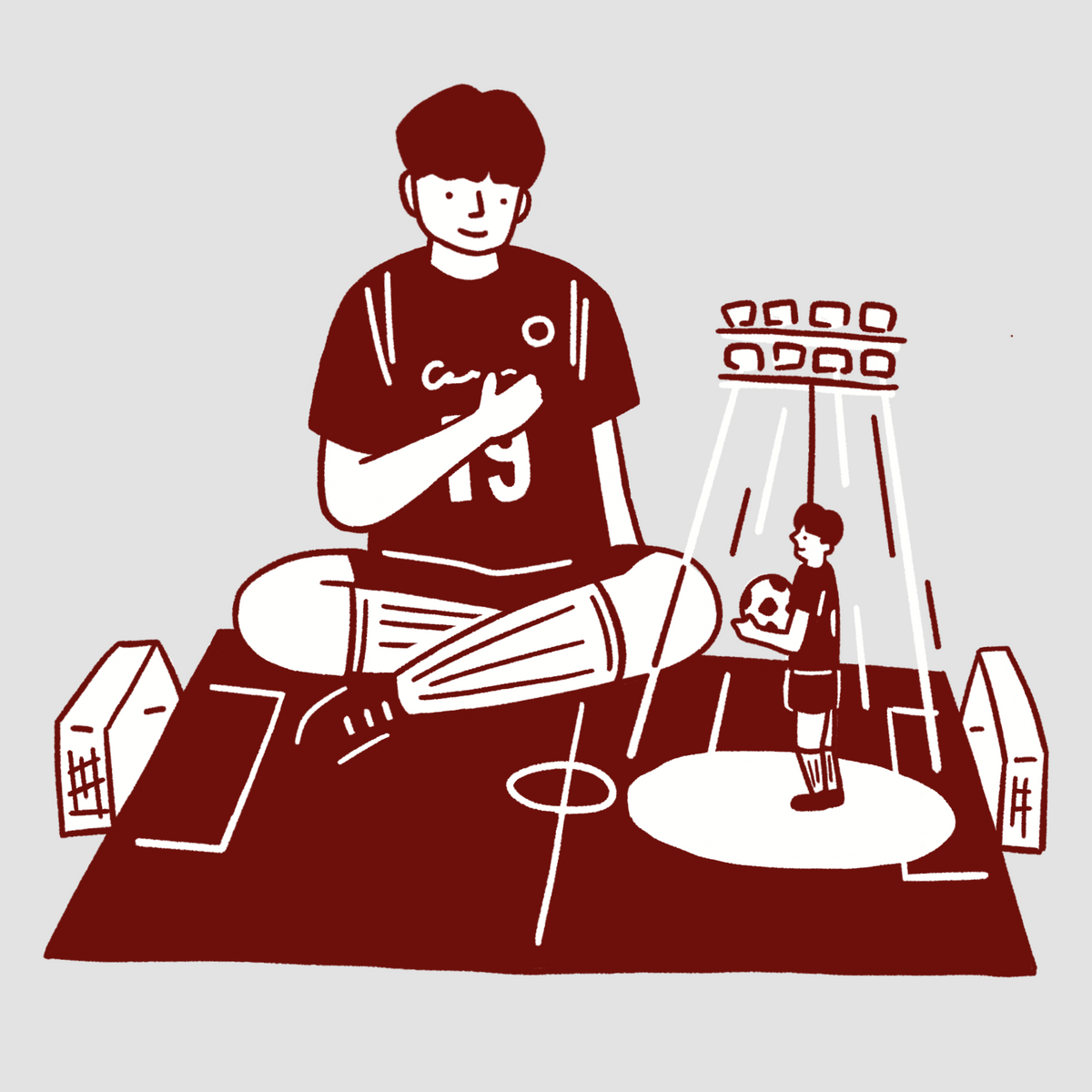
#05 | Lighting a Fire in the Heart and Journeying Through Society
From a Single Flyer in the Mailbox
Connection with others—that is something I have always cherished as a professional soccer player and as I have faced the world off the pitch. My 21-year career has been a continuous series of changes, a journey that has taught me the importance of being there for someone.
My journey began in the quiet routine of everyday life. A flyer for a soccer school had been dropped in my mailbox. The step I took from that moment is the origin of the passion that lit a fire in my heart.
I started playing soccer in first grade. Over the next six years, what I developed was more important than technique or physical fitness: the core belief that I enjoyed soccer and loved the game. It hasn't always been easy. When things aren't going well and when times are tough, this belief is what drives me to keep moving.
In junior high school, I sweated it out with a local club team rather than my school's club, honing my skills against rivals from across the prefecture and beyond. It was an invaluable time when I felt nothing but the pure joy of chasing the ball.
I was a soccer boy with nothing to my name, but I gradually gained recognition throughout the prefecture, was selected as a candidate for the Japan national team in my age group, and began receiving offers from numerous schools and teams. From those opportunities, I decided to play for the youth academy of a J-League team in my hometown of Saitama and resolved to become a professional.
"If I Don't Become a Professional, It's All Meaningless"—The Darkness of My Sophomore Year
When I entered high school, the world of professional soccer became even more tangible. I competed wearing the same emblem as the top team, and supporters came to cheer at my matches. Promising players even participated in top team training despite still being in high school. It was an environment where it was almost impossible not to think about becoming a professional.
In my first year, I was allowed to play from the second half of the national championship final and also participated in top team training. I was by no means overconfident, but I had expectations for myself that if I kept working hard, I might become a professional.
However, during my sophomore year, a crucial period, I was sidelined from matches. I suffered from the gap between the image I had envisioned and reality. If I can't play now, I won't become a professional. If I'm not playing matches now, I won't become a professional. If I'm not participating in top team training now, I won't become a professional. At the time, I was consumed by the anxiety that "If I don't become a professional, it's all meaningless," and I was gradually losing my ability to simply enjoy soccer. I think I was unable to properly process the passion I once had and the meaning of my daily efforts, and the significance I had placed on soccer became distorted.
As I entered my junior year, I suddenly asked myself, "Why do I play soccer?"
The pure feeling of "I love soccer," which was my starting point, had somehow been replaced by something else: "If I don't become a professional, it's all meaningless." Let's enjoy it again. By changing my mindset, I was able to clear my head, and I began to see results in my junior year.
Looking back now, I feel that not giving up during my difficult sophomore year was also a major factor. When things aren't going well and when I fail, I think and take action. Each of those steps is only a small growth, and that alone does not lead to great results. But as they accumulated, before I knew it, they had grown into something substantial. I think that was when my original mindset of "loving" and "enjoying" it finally linked up with my efforts.
In reality, it was very close. When I spoke with the general manager after later being promoted to the top team, I was told that at the time I entered my junior year, I wasn't even considered a candidate for promotion.
While two of my teammates earned professional contracts, I was given a one-month summer break to participate in top team training instead of youth training, testing my path to becoming a professional. I believe I was able to secure that opportunity because of the efforts I had put in since my sophomore year. I still vividly remember the feeling when I spent that intense month and was finally told I would become a professional.
"Why do I play soccer?" The time I asked myself that question in the darkness is what ultimately changed the course of my life.
On the Same Pitch as the People I Admired
My career as a professional soccer player began with Urawa Red Diamonds. At the time, many Japan national team players were on the roster, the stadium was filled with supporters, and there was an environment where I could focus entirely on soccer. No matter how you looked at it, it was Japan's top club.
In three years, we won the J-League, the Emperor's Cup, the ACL (Asian Champions League), and finished third in the Club World Cup. Even now, looking back, it is nothing but a series of brilliant titles. However, I did not play in many of those matches myself.
The senior players who played at the time were truly great, and they were people I admired and took pride in. That is why I felt a huge difference in ability between myself and them. I felt frustrated, but more than that, I believed it was because I lacked skill. I wanted to play matches. I wanted to become better.
Even so, I believe there were many experiences I could have had only because it was the Reds at that time. There is no doubt that Urawa Red Diamonds built my foundation.
"Can You Play a Defensive Position?"
In my fourth professional year, I was loaned to J2 side Grassroots (now Grassroots Gunma), where I played for the first time away from my home club. I still remember how nervous I was about being in a completely different environment for my first transfer. It was a new team that had just been promoted to the J-League. I took on the challenge with determination, knowing that if I didn't produce results here, my path to becoming a professional would be cut short.
The day after the season opener, which I had faced with that mindset, the manager called me in.
"Can You Play a Defensive Position?"
It was a question I hadn't expected, but I understood immediately. It was a position change. From a forward I had played for a long time to a full-back. I could have stubbornly refused, but my desire to be on the pitch was stronger than my attachment to my position, so I readily accepted.
At first, I focused on my weaknesses and did independent training after team practice to overcome my defensive shortcomings. However, I knew that after just a little training, I couldn't expect to be on par with full-time defenders. This is when I reconsidered why the manager had made me a full-back. The manager probably wanted me to contribute to the team with my attacking ability rather than my defensive skills—once I realized that, I focused on my strength in attacking and fought desperately to keep up. As a result, I managed to score six goals in a year despite playing as a full-back.
How to adapt and contribute my unchanging strengths to a new environment and role. That is what I learned that year.
18 years with seven J-League teams, two years in the JFL, and one year in the Kanto League. With changes in teams and managers, as well as position changes, it was a continuous series of changes, but those became my own experiences and personal assets, fostering the flexibility to adapt to diverse environments.
I Want to Be a Player Who Is Loved
During my 21-year career, I especially cherish the seven years I spent at Tokyo Verdy. I played in over 200 matches and scored over 50 goals—it was my most fulfilling time.
In 2011 and 2012, I was with the team for a short time before leaving, but I returned in 2019. At age 32, I scored 16 goals for the first time in my career, finally surpassing the six goals I had scored as a full-back and setting a career high. Then, in 2021, I scored 17 goals. Once again setting a career high at age 34, I became the top Japanese goalscorer in the J2 League (third overall).
I have also looked beyond the pitch. I have always had a strong desire to do something for the people who support me.
This was during my first year as a professional. At the time, the Reds had player postcards, and I was given 5,500 at the start of the season. I remember being genuinely surprised when I was told to work hard to get people to remember my name, sign them, and hand them out. Still, I handed out every single one in my first year and was given more. I don't think any other player handed out as many as I did.
It was the same even after social media became popular. I updated my blog every day for two years and honestly wrote about what I felt even after losing matches. I thought that posting only when things were going well would lack consistency. Even now, I reply to every comment and message.
During my time at Tokyo Verdy, I often saw posts on social media saying, "I wish there were more stadium food options." I thought I might be able to do something about it. So, together with my teammate Ryota Kajikawa, I bought a food truck, painted it in Verdy's club colors of green, and only set up a stall on home game days. It was simply because I wanted to help make Verdy more exciting.
How many matches I want to play in a year, how many double-digit goals I want to score, how many years I want to play as a professional player. I began to set not only quantitative goals like those, but also qualitative goals, such as wanting to know what the supporters are thinking and wanting to make them happy.
As I worked on each goal in parallel, I realized that above those goals was a purpose that had been vague until then: how I wanted to be.
"I Want to Be a Player Who Is Loved"
This is the purpose (the person I want to be) that I want to achieve. Because I have always valued my connection with the people who support me alongside my desire to excel on the pitch, it was only natural for these words to come to mind.
To become a player who is loved, I need to produce results in matches. At the same time, connecting with the supporters is also essential. What I thought were goals were actually all tied to this single purpose. I have finally realized that.
By establishing this purpose, I have gained a core set of values, and my actions have become more consistent. The goals in front of me have taken on a stronger meaning, and my days have become more vibrant.
What I Needed Was Not the Ball
It all began when I was playing for Yokohama FC. An acquaintance asked me if I could visit a children's home that they had a relationship with. To be honest, I only had a casual intention to drop by. I visited with Kajikawa, who was playing for Shonan Bellmare at the time.
However, we were greeted with an incredibly warm welcome. We ended up playing soccer with the children right then and there.
After a while, the children came to the stadium to cheer for us. Because it was a soccer-specific stadium, the pitch and stands were close together, and since I was playing on the wing, I could hear the children's cheers throughout the match. I was so happy.
So, after the season ended, I visited the home in return. Since it had been a while, I was worried that they might have forgotten about me. But the children welcomed me with the same enthusiasm as the first time.
I began to think about whether there was anything I could do for these children through soccer.
The first thing that came to mind was donating soccer balls. However, I realized that might only end in self-satisfaction. So, I told the staff at the home that I wanted to support their activities and asked what kind of support would be best for the children.
The answer I received was different from what I had expected.
Many of the children at the home leave at age 18 to become independent. Some do not have the support from parents that others take for granted, and some are in environments where it is difficult to have dreams or goals. That is why they want me, who fulfilled the dream of becoming a professional soccer player, to interact with them, hoping that it will create a chemical reaction. They said they would be happy if our interactions inspired them to have dreams or goals and gave them the strength to work hard.
What I needed was not a ball. It was to go and see them. And not just once, but to continue going and seeing them. I took the staff member's words back, had repeated discussions with Kajikawa, decided on a form of support, and started the activity under the name F-connect. Later, it became a legal entity, which is now the general incorporated association F-connect.
That Child Changed Their Behavior
There was an incident where I felt the value of sports and the value of an athlete through my interactions with the children. It happened when I visited a children's home.
At first, the children felt distant, but when I started kicking the ball, they approached with lively expressions and joined me in chasing the ball in a circle. I still vividly remember that scene.
"I was surprised that even children who would never play soccer normally were chasing the ball with us."
The staff member said the same thing. I don't know if it was because I was a professional soccer player or because everyone looked so happy, but I feel that the fact that the child changed their behavior is of great value.
Through these encounters and experiences, I began to think that connecting with the thoughts and feelings in others' hearts is what brings true richness. It is not technique or physical fitness, but the movement of the heart. I believe that is the starting point of everything.
To Keep the Fire in the Heart from Going Out, and to Make It Burn Brightly
Currently, in addition to the general incorporated association F-connect, I also run Kotouima Inc. At Kotouima, we conduct organizational development projects and operate a seven-a-side soccer (sociaichi) team as part of our sports business.
The concept of our organizational development business is "to nurture people and organizations, and create fans." An organization functions not only through systems and strategies, but also through the connection of "people's hearts." Organizational development that supports the growth of people, teams, and organizations, and branding that creates attachment (fans) both inside and outside the company. We support the creation of organizations that develop sustainably through these two pillars.
The club mission of our seven-a-side soccer team is "Light a Fire in the Heart." Everyone has a chance. I want you to see the sight of people lighting a fire in their hearts, having passion, and taking on challenges. We will continue to strive to become a team that can succeed in the world, and we want to deliver the original experience of dreams and excitement to people all over the world.
When I write it all out like this, everything is connected.
A single flyer lit a fire in my heart. The voices of the supporters moved me on the pitch. And the children came up to me while I was kicking the ball. Now I am doing for others what was done for me. I think that is all there is to it.
The feeling of "loving" that I have cherished is at the core of my current activities.
The people I met while playing for nine clubs, and the children I met through F-connect. From these connections, I have gained a great deal of insight and learning. The society I have traveled through may have ultimately been the hearts of each and every one of those people.
I am turning 39 this year, and while I am by no means young in the soccer world, I want to keep lighting a fire in my heart through soccer and business, doing everything I can now with all my might, and continue to grow.
What do you cherish? If this text gives you a chance to think about the richness of your life, I could not be happier.
Thank you for reading this far. I would be happy if my experience could be of even a little help to you. Let's meet again.

Junki Koike
Born in 1987 / From Saitama Prefecture
After graduating from high school, he joined the J-League team Urawa Red Diamonds,
While active as an athlete, he founded Kotouima Inc.
Illustration by @Naoto Takamatsu