#02 | Living Among People - Part 2
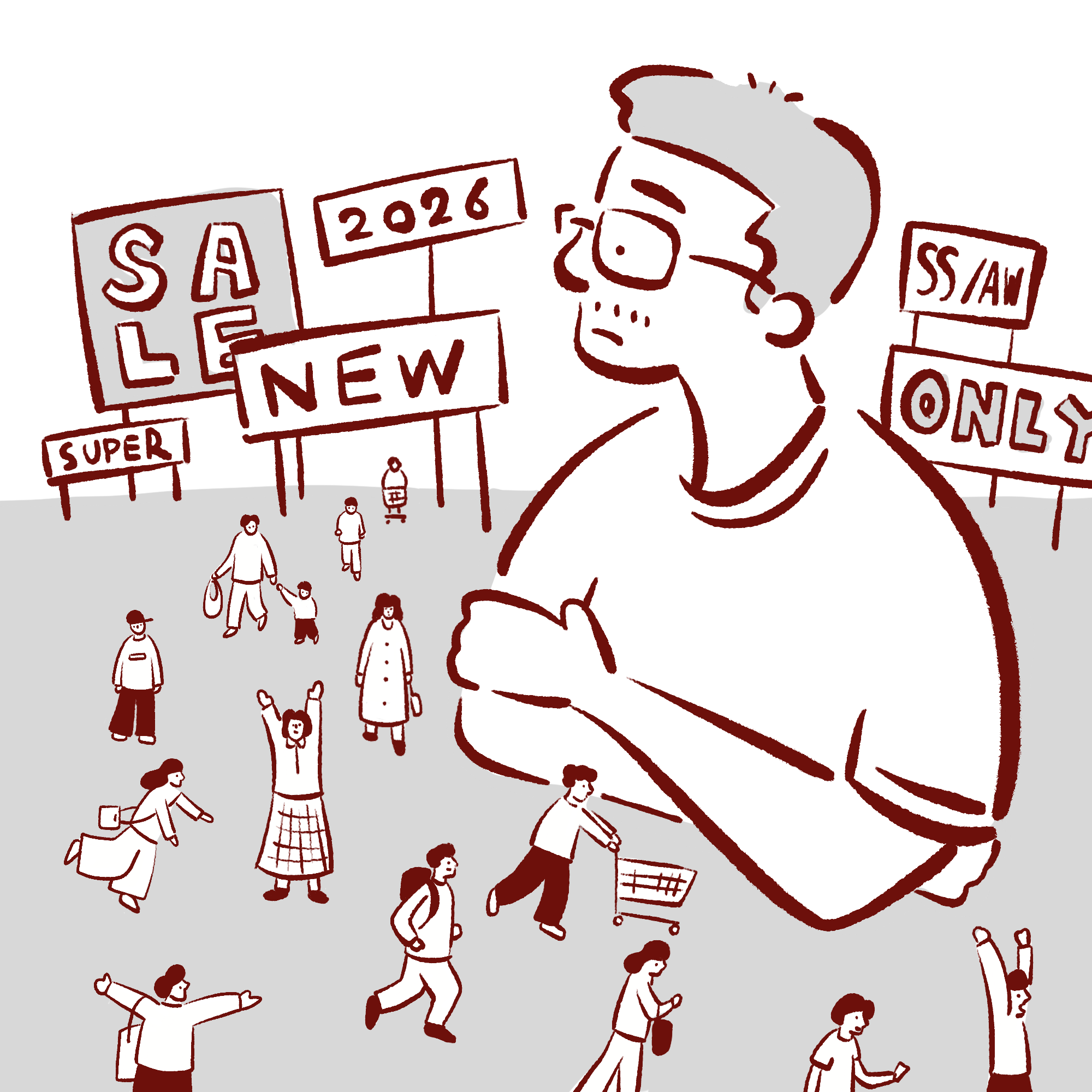
"Society" is a large entity made up of strangers
However, it feels a little strange to view "society" through the lens of a rice-cake pounding event involving a few dozen people.
This is because when we ordinarily use the word "society," we assume a rather large group of people. For example, in Japan, if you use the word "society" in Japanese, most people will envision "Japanese society." How does a "society" of 120 million people relate to a rice-cake pounding event?
In fact, the use of "society" (from the Latin, meaning "companion") began to change around the 18th century. That is, it began to approach the meaning of "society" that we use today.
This is because, in Europe, ideas emerged that separated "civil society" from "the state ruled by kings."
For example, to introduce the concept of "social contract" as conceived by John Locke and Rousseau, "society" as a place for citizens to make contracts with each other became indispensable. After the French Revolution, the concept of "society" became important as a term referring to the entire nation, transcending the status order of nobles and commoners.
Then, Auguste Comte proposed "sociology" and, separating it from the state, made "society"—as an "overall system operating according to natural laws"—an object of study.
Thus, the concept of "society" as "a gathering of strangers," which we vaguely perceive today, came into being.
Since Comte proposed sociology, research on "society" has also progressed.
For example, Émile Durkheim conceived of "society" as a persistent order based on norms. In other words, he believed that "society has rules that must be observed, regardless of people's feelings." Examples include laws and morals. On a smaller scale, there are ways of greeting or school rules. We didn't decide these rules ourselves, but if we don't follow them, we might be reprimanded or punished. This external force that binds us was called "social facts." What Durkheim wanted to say was that "society" is not just a collection of people. It can be called "society" precisely because everyone shares the same rules, allowing them to act with peace of mind.
The reason we can feel secure is that having rules allows us to predict, "This person will probably act this way." Because we can predict, we can cooperate, and society can come together (solidarity).
Georg Simmel, on the other hand, believed that "society is not a thing, but the interaction itself between people." He argued that the smallest unit of "society" is not a "person," but the relationship between people. For example, conversations with friends, the relationship between a teacher and a student, or the interaction between a store clerk and a customer. As these interactions continue, forms such as "hierarchy," "rivalry," and "cooperation" are created. Simmel believed that these interactions have certain "patterns" such as competition, cooperation, conflict, and obedience. "Society" is formed by the repeated occurrence of these patterns of interaction.
In other words, "face" and "position" are also important. Not making someone lose face and maintaining one's role are what sustain relationships. The flow of relationships created by the accumulation of daily interactions forms "society."
Niklas Luhmann offers a somewhat eccentric explanation. He believed that "it is not people who make society, but communication." He stated that "society" is a mechanism where interactions such as speaking, conveying, and understanding continue. For example, news is reported → people talk about it → discussions spread further, in which communication generates the next communication.
This continuation is called "autopoiesis."
Modern society has various fields. In the world of law, it's "legal or illegal"; in the world of economics, it's "to pay or not to pay"; in the world of politics, it's "to have power or not"… Each field operates according to its own unique rules. "Society" is the whole in which these multiple mechanisms operate simultaneously.
Some sociologists have put forward the idea that, since it is a whole, it is not just humans. Bruno Latour is one such sociologist. He argues that documents, computers, apps, buildings, and roads also drive society. For example, cars stop because there are traffic lights. School rules are followed because they are written on paper. You can't enter because there is a password.
In other words, objects and systems also determine behavior, just like people. "Society" is a network formed by the connection of people and things.
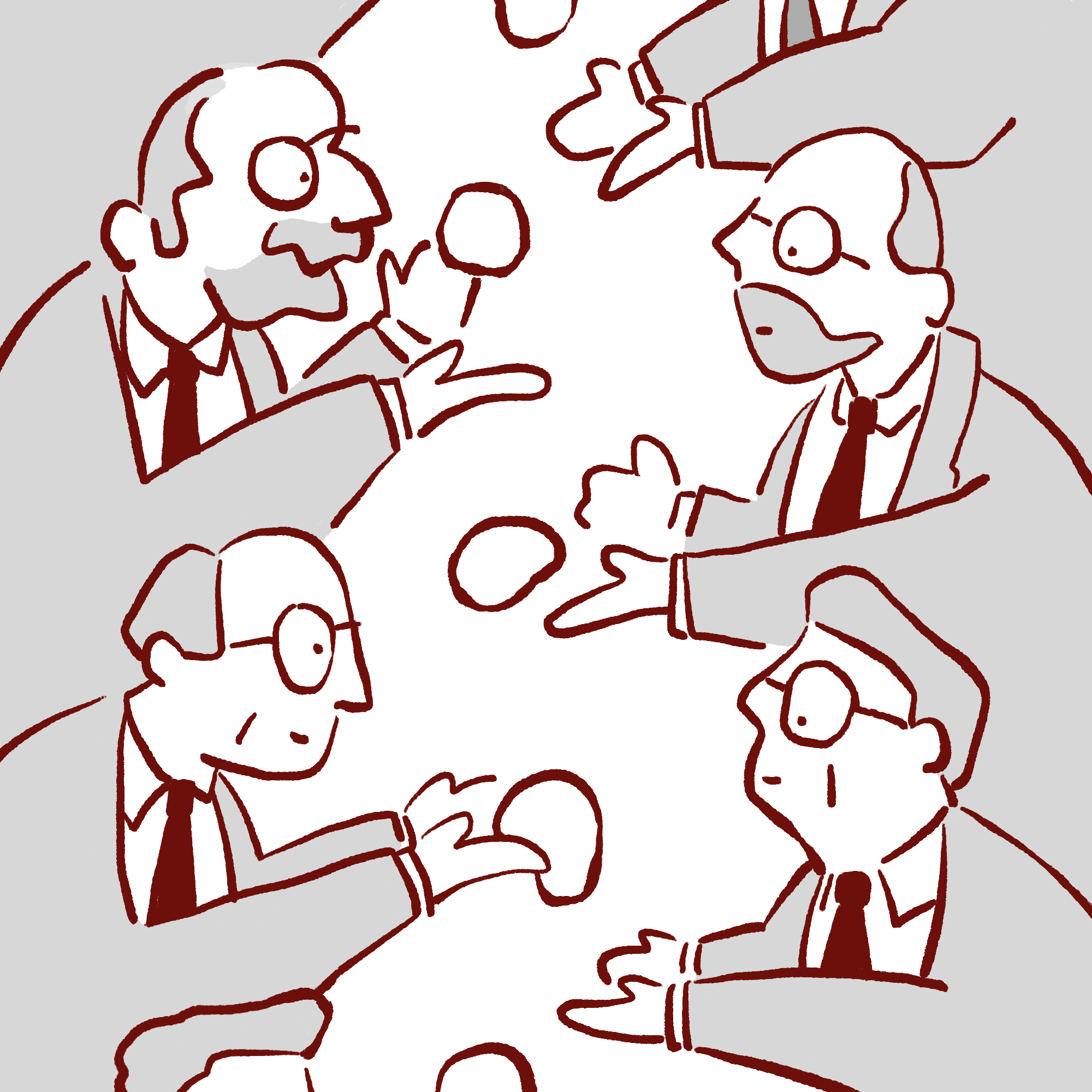
So, we've invited four sociologists and had them introduce their respective views.
Durkheim said that "society" is made up of "rules that everyone follows," Simmel said that "society" is made up of "interactions between people." Luhmann said that "society" is made up of "the flow of communication," and Latour said that "society" is made up of "connections between people and things."
"Society" has various perspectives and many facets. These discussions involve theories that are in mutual tension, so it is inappropriate to try to synthesize them. Acknowledging that it is inappropriate, but roughly speaking, let's try to summarize it this way for now: Society is like a network in which people, things, and information constantly move back and forth according to some rules.
Next, I want to consider the relationship between us as "individuals" and "society."
In other words, why can "thinking about mochi pounding" be considered the same as "thinking about Japanese society"?
Entering "Society"
"Society" has "rules," "relationships," "communication," and a "network composed of people, things, and other elements."
I apologize for calling on another person so soon, but let's invite another cultural anthropologist here: Marcel Mauss.
He wrote a very famous book called "The Gift." This book features a truly diverse range of people from ancient and modern times, from North America to the West Atlantic, and from ancient Rome to the Germanic peoples. And Mauss argued that these diverse peoples actually exchanged goods through "gifts."
Let's clarify a bit.
In the 21st century, if we want something, we pay money and buy it at a store. We exchange money for things. We make equivalent exchanges. And we somehow assume that before money appeared, people bartered (equivalent exchange) things of roughly equal value. This is not a correct understanding.
Mauss realized that before buying and selling (equivalent exchange) in the market became widespread, people exchanged goods by giving them to each other as presents.
You might think, "If they were exchanging things, then it was barter!" But in reality, it's different. It's more like summer and year-end gifts.
If someone sends us a box of beer as a summer gift, we generally don't do something so uncouth as to send back exactly the same box of beer. Instead, we'd probably send back something like a fruit jelly set or a wine set that seems to be of roughly equivalent value.
We strive for rough equivalence, but not a strict equivalent exchange.
Rather, we would probably try to give a slightly more generous return gift than the other person. Someone who gives a cheaper gift and rejoices, "Yay! I got a bargain!" is considered "lacking in refinement."
Through his research on various customs around the world, Mauss realized that human groups might have three obligations: the obligation to give gifts, the obligation to receive them, and the obligation to reciprocate. In some cultures, those who violate these obligations might even be enslaved. At the very least, in most societies, people who fail to fulfill these three obligations are not respected.
Well, that was a long preamble.
I believe that what is necessary for humans to enter "society" is to participate in this network of gift-giving.
Pounding rice cakes at a rice-cake pounding event can be a form of gift-giving. It's doing something for everyone. It's a gift to all participants of the rice-cake pounding event. And each participant distributed sake, rolled rice cakes, collected trash, and cleaned up. Each person performed an act that benefited everyone. In other words, reciprocity was taking place.
People work for others, and are sustained by the work of others.
To that end, rules exist, relationships are cultivated, communication occurs, and a network including people and things is formed.
In other words, to enter into society, it's good to work for everyone.
"Work" as a way to be in "society"
Now, let's talk about "work."
This is a discussion about "individuals," "society," and "work." Let's consider "work," the final piece.
We are said to live in a "capitalist society." A "capitalist society" is one where free markets and private property are recognized. A free market is a place where people can exchange (buy and sell) anything with anyone. For us, who are accustomed to Mercari and Rakuten, "being able to exchange anything with anyone" might feel so natural that it's anticlimactic.
But in fact, it's not always so. For example, during the Edo period, in some domains, paper, sugar, salt, wax, and tobacco could not be freely bought and sold. Even without going as far back as the Edo period, tobacco, salt, and alcohol could not be freely bought and sold during wartime. If the government can arbitrarily decide who can buy and sell what, it cannot be called a free market.
The same applies to property. If the government or the king can arbitrarily seize people's property, it cannot be called private property. A society can be said to have private property if individuals' right to own property is strictly protected. We generally don't have our bank accounts frozen by the government unless we do something truly egregious.
In other words, we can own our property and live by freely buying and selling it in the market. This is a "capitalist society."
In a "capitalist society," buying and selling is the basis of exchange. Unlike the gift exchanges Mauss described, exchanges like buying and selling seem to deepen human relationships very little. If people exchange mid-year and year-end gifts, they gradually become closer, or at least personal relationships continue, but it's difficult to become personally close to the same clerk every day when buying coffee at a convenience store.
Furthermore, in the latter half of the 20th century, there was an expansion of economic zones, known as globalization. While people in an Edo period farming village probably ate mostly locally grown food every day, in the 21st century, we can eat curry containing chicken raised in Brazil and pork raised in Spain, served with rice grown in Thailand. The economies of the entire planet are connected. It is extremely difficult to live solely on products made by "producers whose faces you know."
What this means is that in a globally expanded "capitalist society," it is absolutely necessary to live alongside strangers.
We live in our familiar hometowns, spending time with friends from childhood, while also interacting with unknown others.
In fact, in our society, almost everyone is thrown into their own society, just like a cultural anthropologist going into the field for the first time, or me going to a rice cake pounding event.
And the way to participate in this society is precisely through "work." "Work" is not limited to labor that earns wages. "Work" is an act that benefits others. Even if it doesn't earn a penny, if you upload a novel to the internet, it can be called "work," and housework and childcare, which are often not considered "labor," are splendid, or rather, exceedingly splendid "work" in the sense that they "benefit someone."
When we look at "work" in this way, we also realize that buying and selling in a "capitalist society" is not, in reality, such a heartless and cold system. We cannot always avoid forming human relationships when we buy and sell.
Just as I became a regular at a bar, if I go to my favorite diner, a relationship with the proprietress will form, and if a relationship with the proprietress forms, relationships with other regulars will naturally form. This is probably because it is actually rare for buying and selling to be purely buying and selling; a gift-like act inevitably gets mixed in.
When helping others through "work," no matter how much reward or salary is paid, other forms of giving, such as a little consideration or thoughtfulness, are inevitably exchanged in addition to labor. Is it not that "work that helps people" inevitably becomes an act of giving?
I doubt we often feel this in our daily lives, but in fact, we can probably find "gift-giving" through "work" even from Brazilian chickens, Spanish pigs, Thai rice, Chinese electronics, and Vietnamese clothing.
In summary, this is it: We are constantly thrown into a "village of strangers"—the global capitalist society. To enter that village, we need to be useful to someone. That becomes "work." By doing "work," someone else helps us in return. As "work" connects with "work," we help each other. And, just like "making one mochi," we share "work" with people doing completely different tasks. That is, we can also work together (collaborate). This mutual aid creates a network within the connections of people, things, and information, and we roughly call that "society."
What I am giving in "society"
So, I considered "society" to be "a place for collaborative relationships with strangers through work." "Individuals" try to find their place in relationships with strangers and "work" to be useful to people. This network, through "work" or giving, connects strangers and creates "society."
So, what am I giving?
I have received the tutelage of "knowledge" from my teachers and previous researchers. Unfortunately, due to my own capabilities, I haven't been able to fully absorb that "knowledge" and elevate it into new "knowledge." However, I intend to do the "work" of utilizing "knowledge" in my own way to make it more useful for people.
If, after hearing my story, you spare even a moment to reflect on the relationship between your "work," "society," and "yourself," I hope you will consider it a gift from me.
And I believe that this is also what wonder baggage wanted to give to all of you, through me.

Ryunosuke Murokoshi
Anthropologist, writer. Specializes in cultural anthropology. After completing the doctoral program at Kyushu University's Graduate School of Human-Environment Studies, he withdrew with completed credits and worked at overseas diplomatic missions and venture companies before becoming independent. He runs a private seminar, "le Tonneau," and provides research for corporations, as well as training and study groups for executives and consultants. He hosts the podcast programs "Norajio" and "Shin Nihon Dajare Kyokai."
Illustration @Naoto Takamatsu