Article: #01 | Living Among People - Part 1
#01 | Living Among People - Part 1
When I’m with people
Why do we work?
This is a question I don't even know where to begin to answer.
Since I have no idea where to even start, I’ll begin with a small anecdote.
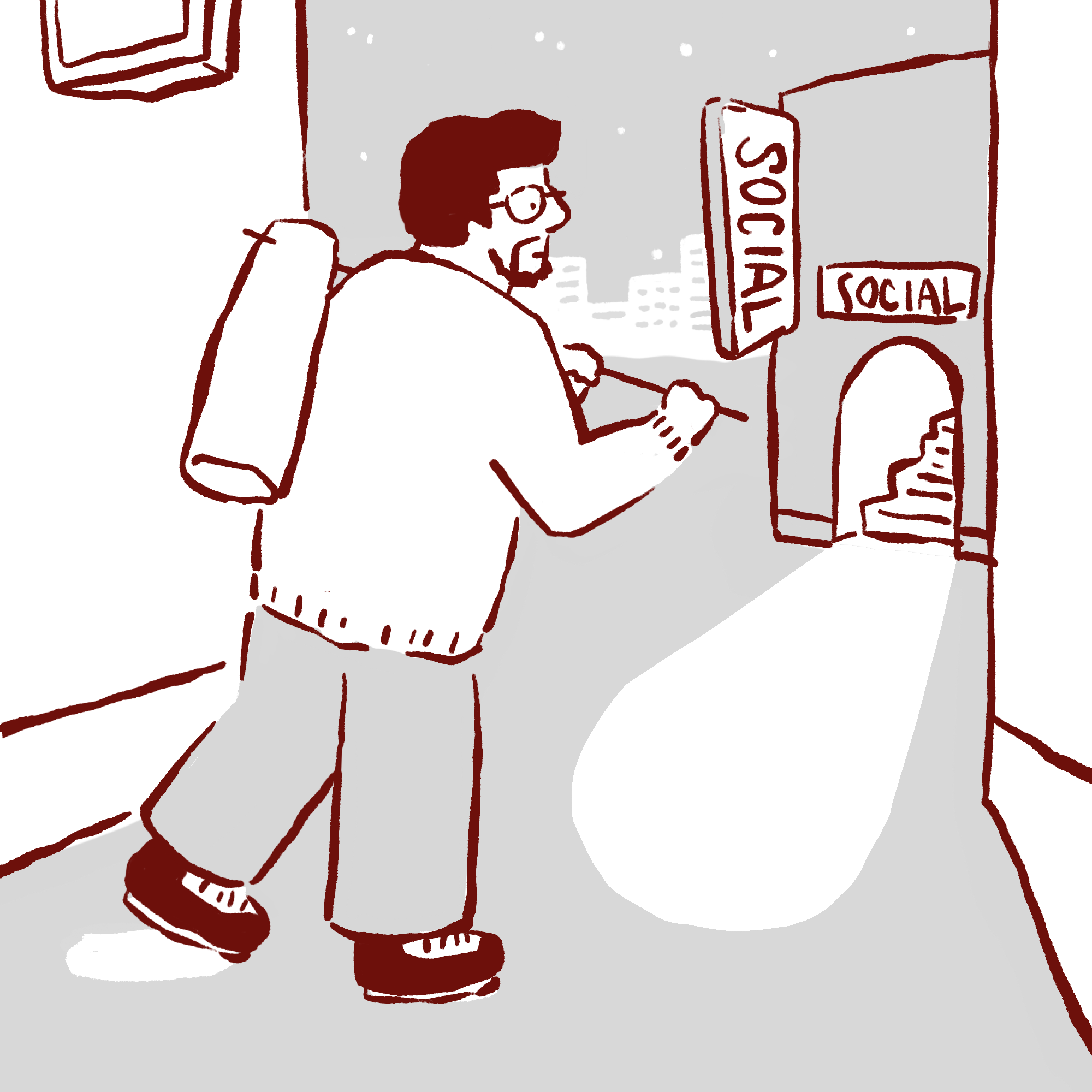
So, you arrive in a village you don't know. You don't know anyone. You have no work to do in that village, and you don't belong to any local organization like a school or an NGO. But you're going to live there for at least a year and live with the people who live there.
Could something like that really happen? Wouldn't that be a strange situation, one you've never experienced before?
You have to live in an unfamiliar place where you don't know anyone. It's rare for us to find ourselves in such a situation. Normally, we have family and relatives around our homes. Even if not, we have friends we met at the sandbox in the park, or at nursery school or elementary school. We know where our house is in the village, where we can buy food, and who to consult if we're in trouble. This is normal.
Perhaps some people have experienced moving to unfamiliar places many times because their parents were transferred frequently, or because they themselves happened to have jobs that required frequent transfers. But even in such cases, there must be a school to attend or a workplace to go to. Of course, it might be difficult to adapt to the new place they moved to. But at least their status as a student attending that school or an employee working at that company is guaranteed.
So, is it impossible to live for years in an unknown land where you don't know anyone and have no status?
It is possible.
There is a job where you voluntarily experience such things.
That is, being a cultural anthropologist.
Cultural anthropology is a field of study that researches human societies and cultures. In many cases, it involves long-term fieldwork in foreign countries. In cultural anthropology fieldwork, researchers live with local people in the towns or villages of the people they want to study for a relatively long period, typically one to two years, to investigate their society and culture. They don't just conduct interviews or observe people's lives; they employ a method called "participant observation," where they try to understand the local people by immersing themselves in their lives as much as possible—for example, carrying a portable shrine with them during festivals or carrying game with them if they go hunting.
It is generally difficult to integrate into a group of strangers in an unfamiliar place.
This is because you don't know if someone is approachable, what kind of person they are, or what kind of person would be accepted.
In some cases, by studying a region that your professor or senior researcher has previously investigated, you might be able to start your research in a place where you already know someone. But that's not always the case. There are young researchers who arrive in a completely unfamiliar place, knowing no one, with only the certainty that they will "be there for a year."
I am one of those people.
In September 2011, at the age of 22, I went to Cuba alone. But I didn't know a single soul. My Spanish was clumsy. I arrived in the country relying only on the taxi fare from the airport to the city center, which I had gleaned from "Chikyu no Arukikata" (Globe Trotter's Guide) and "Lonely Planet."
My case from that point on is not very reliable due to some rare good fortune. At the lodging house I managed to reach, the landlady handed me a note. The note was left by a Japanese person who had lived in that lodging house before me, and it contained the contact information for their Cuban friends. I called those Cubans as instructed by the note. The people I met then were my friends throughout my research life, and even though it's been 8 years since I stopped going to Cuba, we still keep in touch.
By spending time with these friends, I somehow found my place in Cuban society and was able to keep visiting for many years.
Unfortunately, my own field experience wasn't very suitable for this topic, so let's examine the experience of "entering among strangers" through other anecdotes.
Currently, I also have a base in Tokyo.
Since I am originally from Kyushu, my main bases for a long time were Oita, my hometown, and Fukuoka, where I spent my student life. It hasn't been long since I started spending a lot of time in Tokyo. It's an unfamiliar place, a place where I don't know anyone, just like when I first went to Cuba. Fortunately, the situation isn't much different, except that Japanese is spoken.
There are other differences besides language. This time, there was no note. I didn't have a note connecting me to my "first friend." So, what was I to do?
Some time after I arrived in Tokyo, an acquaintance took me to a bar. The drinks served there were unusual and delicious, and I immediately fell in love with the place. From then on, I visited that bar many times. On my first New Year's Eve in Tokyo, I ended up spending it at that bar, having nowhere else to go.
Eventually, I was invited to a mochi-making event hosted by the bar.
The bar owner had invited customers to a mochi-making party.
I'm not good at parties with many strangers, so I hesitated to participate. Normally, I would have declined. But I reconsidered, thinking that opportunities to naturally blend in with strangers—that is, people in Tokyo—don't come along very often, so I decided to participate.
On the day, I was told to "wear clothes you don't mind getting dirty," so I decided to wear an apron. When I arrived at the venue, there were many people dressed stylishly. There was no one in a "community center mochi-making" style, wearing a full tracksuit and an apron. I was out of place from the start.
While there were a few acquaintances I had made in Tokyo, most of the dozens of people gathered were strangers. I took the drink I was offered and stood there, dumbfounded.
It's the same at a bar, a diner, or a gym. There are "people you somewhat recognize" nearby. At that moment, whether to strike up a conversation or not is a big decision. And I tend to choose the latter.
If there's a bar owner or a diner proprietress, they might skillfully connect regulars who "somewhat recognize each other." But in a gathering of dozens of people, there's a limit to how much a "host" can connect people.
Just as I was beginning to regret coming to the mochi-making party for no clear reason, someone cheered, "The glutinous rice is cooked!" Suddenly, several men began to moisten the pestle and mortar. The glutinous rice, carried in by two people, was poured into the mortar. Men with pestles began to pound the rice. When the rice was nicely crushed, a voice called out, "Does anyone want to pound mochi?"
I raised my hand at that moment and pounded the mochi.
As I swung the pestle with all my might, the onlookers naturally started to cheer, "Yoisho! Yoisho!" The venue livened up as I pounded the mochi.
Mochi is great.
It unites a group.
After pounding mochi for a while, I handed the pestle over to the next person.
After that, I cut, rolled, and distributed the mochi to people.
While I was working, my discomfort gradually disappeared.
Making mochi surprisingly involves many steps, and making enough mochi for dozens of people indeed requires coordination.
Dozens of strangers work together to produce mochi at an incredible speed. (Because if you don't hurry, the mochi hardens. You can't dawdle.)
Humans interact organically, moving like a single organism. Cooking the glutinous rice, pounding the mochi, cutting it, rolling it, seasoning it, and distributing it. It's an amazing coordination.
Here, I saw "society."
What is "Society"?
So, what is "society"?
The Nihon Kokugo Daijiten (Japanese Language Dictionary) describes it as follows: "A gathering of people. A form in which people gather together to live communally. Also, in modern sociology, it is used as a general term for all collective life that humans constitute, whether natural or artificial."
In other words, a place where people gather is "society" itself.
Originally, the concept of "society" was imported into Japan during the Meiji period from the English word "society" and similar European language concepts. The Japanese translation "shakai" (社会) was originally taken from classical Chinese. In Chinese, "sha" (社) means "a place where the god of the land is worshipped," and "kai" (会) means "a gathering of people." So, "shakai" refers to a gathering of people who worship the god of the land.
This word was chosen as the translation for "society" because it carries a similar nuance. The English word "society" comes from the Latin "societas" via French, and "societas" reportedly meant companionship, community, association, or alliance.
Furthermore, the etymology of "gesellschaft," the German word for society, is said to mean "companions in the same room," so there is indeed a commonality in meaning.
In other words, a gathering of "companions" is the essential concept of "society."
Moreover, these "companions" did not refer to blood relations like family or relatives, nor to geographical ties like neighbors, but rather to connections based on contracts, cooperation, and common goals. In essence, the original nuance of "society" was a collection of human relationships formed through "work."
Now, let's go back to the story of mochi pounding for a moment.
I mentioned that, as a solitary individual among a group of strangers, I assimilated into the group through the act of "pounding mochi." I believe this is because the act of "pounding mochi" has a slightly different nature from actions like "fiddling with a smartphone," "drinking alcohol," or "standing still, dumbfounded."
How about we consider it this way?
"Mochi pounding" has two aspects that differ from other activities.
One is that it can be regarded as "work."
The other is that this "work" is "for everyone."
I couldn't monopolize the mochi I pounded. This might seem obvious, but we also hold slightly different notions in our daily lives.
Even when we work at a company, we don't share our salary with strangers. Even when we invest, we don't share the profits or losses with anyone. In our daily lives, we monopolize the compensation for our work.
But "pounding mochi" is clearly "for everyone." In the first place, I "pounded mochi to distribute to everyone." More precisely, I was just one cog in the machine within the setting arranged and orchestrated by the bar owner. However, I could have avoided cooking the glutinous rice, pounding it, cutting it, or rolling it. I could have simply eaten the mochi.
But if I had simply received something made "for everyone," I would never have felt comfortable.
It was through "work for everyone" that I was accepted by the people.
In other words, something close to the Latin concept of "societas"—creating with companions through work—occurred.

Ryunosuke Murokoshi
Anthropologist, writer. Specializes in cultural anthropology. After completing the doctoral program at Kyushu University's Graduate School of Human-Environment Studies, he worked at an overseas diplomatic mission and a venture company before becoming independent. He presides over the private seminar "le Tonneau." He provides research for corporations and training and study groups for managers and consultants. He hosts the podcasts "Noradio" and "Shin Nihon Dajare Kyokai."
Illustration: @Naoto Takamatsu